
What Is Video Marketing and Why Does Your Business Need It?
At its core, video marketing means using visual, moving content to showcase your business, share your story, educate your potential customers, and guide them toward taking action. Whether you are running a boutique in Southlake, a family restaurant in Keller, or a plumbing company serving the entire DFW area, video gives your business a face and a voice that static images and text simply cannot match.
Why is this so important right now? Consumers today are completely swimming in visual content. In fact, video made up over 50 percent of all global internet traffic, and adults spend nearly 2.5 hours every single day watching digital videos. If your business relies entirely on text and basic photos to capture attention online, you are missing out on the majority of your potential audience.
The data speaks for itself. According to the State of Video Report: Video Marketing Statistics for 2026, 89 percent of businesses now use video as an active marketing tool. That is up dramatically from just 63 percent a few years ago. Even more impressive, 87 percent of everyday consumers report that watching a brand’s video directly convinced them to purchase a product or service.
When local shoppers search for services in places like Roanoke or Trophy Club, they want to feel confident before handing over their hard-earned money. Video creates an immediate sense of familiarity and credibility. It bridges the gap between a stranger clicking on your website and a loyal customer walking through your front door.
Building Trust with Video Marketing
Trust is the ultimate currency for any local business. When someone needs a service or wants to buy a local product, they are looking for proof that you are honest, capable, and easy to work with.
Nothing builds human connection faster than seeing real people on camera. When you show your actual team working, give a behind-the-scenes look at your shop in North Richland Hills, or share authentic customer stories, you eliminate the uncertainty that keeps people from reaching out. Human brains process visual information tens of thousands of times faster than written text, and seeing a friendly face triggers trust far more effectively than reading a sales pitch.
In addition to building emotional trust, video plays a major role in expanding your organic reach. Search engines and social media algorithms heavily prioritize engaging content formats. Pages that feature relevant videos hold visitors on the site much longer, which signals to search engines that your website offers real value. If you want to elevate your brand’s look and feel, exploring professional Services – Photography and Videography can help you stand out from the competition with polished, high-impact visuals.
Guiding Customers from Discovery to Sales
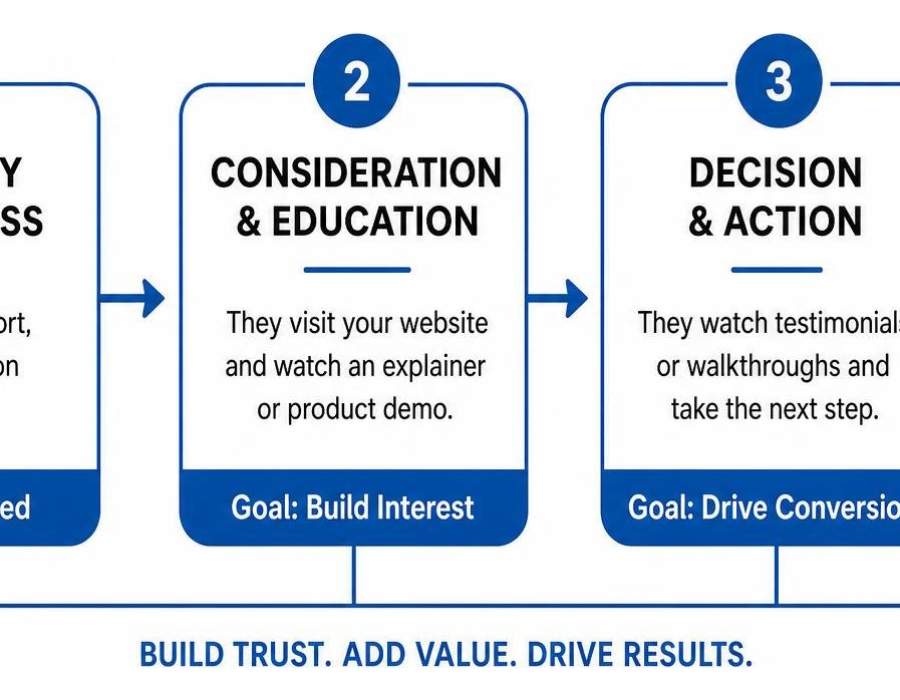
Understanding how video works across the entire buyer journey makes your efforts much more effective. Think of the buying process as a simple path that every customer walks down:
- Discovery and Awareness: A local resident scrolls through social media and discovers your short, fun video showing a creative tip or a quick community spot in Fort Worth.
- Consideration and Education: Interested in your services, they visit your website and watch a 90-second explainer clip or a simple product demo that breaks down how you solve their specific problem.
- Decision and Action: Before making a final choice, they watch a heartfelt customer testimonial or a short video walkthrough that answers their final objections, giving them the confidence to call or buy.
This full-path approach ensures you are not just making noise online, but active step-by-step progress toward generating revenue. To dive deeper into tracking how these touchpoints convert viewers into paying clients, check out this detailed guide on How to Measure Video Marketing Performance.
How to Create a Simple Video Strategy on a Budget
Many small business owners freeze up when they hear the term “video strategy.” They picture thousands of dollars in high-end camera gear, full production crews, and complicated studio setups. The reality of modern marketing is much friendlier.
Almost 40 percent of businesses spend under $5,000 annually on video production, and over half of companies manage their video content with small internal teams or simple local partnerships. You do not need a Hollywood budget or fancy graphics to succeed. In fact, overproduced videos can sometimes feel cold and corporate, whereas simple, authentic videos often perform significantly better for local businesses.
Building a budget-friendly video plan comes down to preparation rather than expensive equipment. By organizing your ideas, establishing a basic content calendar, and sticking to a clean script outline, you can produce consistent videos without burning through your time or budget.
Defining Your Goals and Audience
Before hitting the record button, you need to answer two basic questions: who are you speaking to, and what do you want them to do?
Start by thinking about your daily operations in Keller or the surrounding DFW communities. What are the top five questions customers ask when they call your business? What common misunderstandings hold them back from buying?
Your primary goal might be to:
- Increase local brand recognition across Southlake and Trophy Club
- Explain a complex service so sales calls go smoother
- Show off product features to boost online storefront sales
- Encourage existing customers to leave reviews or refer friends
Once you define a clear objective for each video, keep your message focused on one core topic. Do not try to explain your entire business history, list ten services, and offer a discount all in one sixty-second video. Focus on solving one problem or answering one question per clip.
Choosing the Right Video Formats for Beginners
When you are starting out, stick to simple, proven video formats that deliver maximum value with minimal friction:
- Explainer Videos: Quick 60 to 90 second clips that break down a product, service, or common problem. For instance, a roofing contractor can explain how to spot storm damage, or a local gym owner can show three easy exercises for beginners.
- Product Walkthroughs: Show your product in action. If you run a retail boutique, walk viewers through your newest seasonal inventory. Two-thirds of shoppers prefer watching a short demonstration to understand a product over reading a description.
- Customer Testimonial Videos: Ask a satisfied local customer to speak briefly about their experience working with you. Authentic words from a real neighbor hold immense power.
- Behind-the-Scenes Clips: Show the hard work, care, and personality that goes into your daily work. Showing your morning prep routine or team introductions humanizes your business instantly.
For a fresh list of creative starting points you can use right away, check out these 10 Video Content Ideas You’ll Love.
If you want to achieve clean, clear visuals and crisp sound without confusing equipment, you can learn practical setup tips in our guide to Achieve Studio Quality Results with Simplified Video Setup.
High-Impact Video Formats and Platforms for 2026

The landscape of online media has evolved, making video more accessible than ever for local entrepreneurs. Vertical video formats (1080×1920 resolution) designed for mobile devices have seen explosive growth, with uploads rising dramatically over the past year. Since over 70 percent of online video views happen on smartphones, optimizing your content for vertical viewing is essential.
Another crucial factor for success is accessibility. Around 90 percent of video teams now incorporate accessibility features into their publishing routine. A huge portion of social media users watch videos with the sound turned completely off while commuting, sitting in waiting rooms, or scrolling at night. Adding readable captions and text overlays ensures your message gets across even when audio is disabled.
Social Media Platforms for Video Marketing
Not all social media platforms require your attention at once. It is far better to select one or two platforms where your target audience spends time and show up consistently than to spread yourself thin across six different networks.
Here is a breakdown of where businesses are finding the most success:
- LinkedIn: Surpassing other channels, LinkedIn has become the number one platform for professional and business-to-business content, used by over 80 percent of companies. If you offer professional services, commercial contracting, or corporate catering in the DFW area, LinkedIn is ideal for reaching decision-makers.
- Instagram (Reels and Stories): About half of all business teams use Instagram to share vertical video clips. It is perfect for visual industries like dining, fitness, home remodeling, beauty, and local retail across Southlake and Keller.
- YouTube: Used by 76 percent of businesses, YouTube remains the second-largest search engine in the world. It is the premier home for evergreen content, detailed how-to guides, and tutorials that continue driving views and leads for years.
- Facebook: Facebook remains a staple for local community networking, neighborhood groups, and reaching suburban families across Texas towns like Trophy Club and Roanoke.
To master creating high-converting short clips for these platforms, read The Ultimate Guide to Short-Form Video Advertising and explore Creative Video Ideas for TikTok to Boost Your Engagement Overnight.
Repurposing Long Content into Short Clips
One of the biggest hurdles small business owners face is finding the time to produce content regularly. Over half of marketing teams spend more time producing videos than promoting them. The solution to this problem is content repurposing.
Instead of trying to create ten brand-new videos every week, record one core piece of long-form content, such as a 20-minute presentation, a local workshop, or a live Q&A session. From that single recording, you can easily pull out five to eight short, engaging clips for social media.
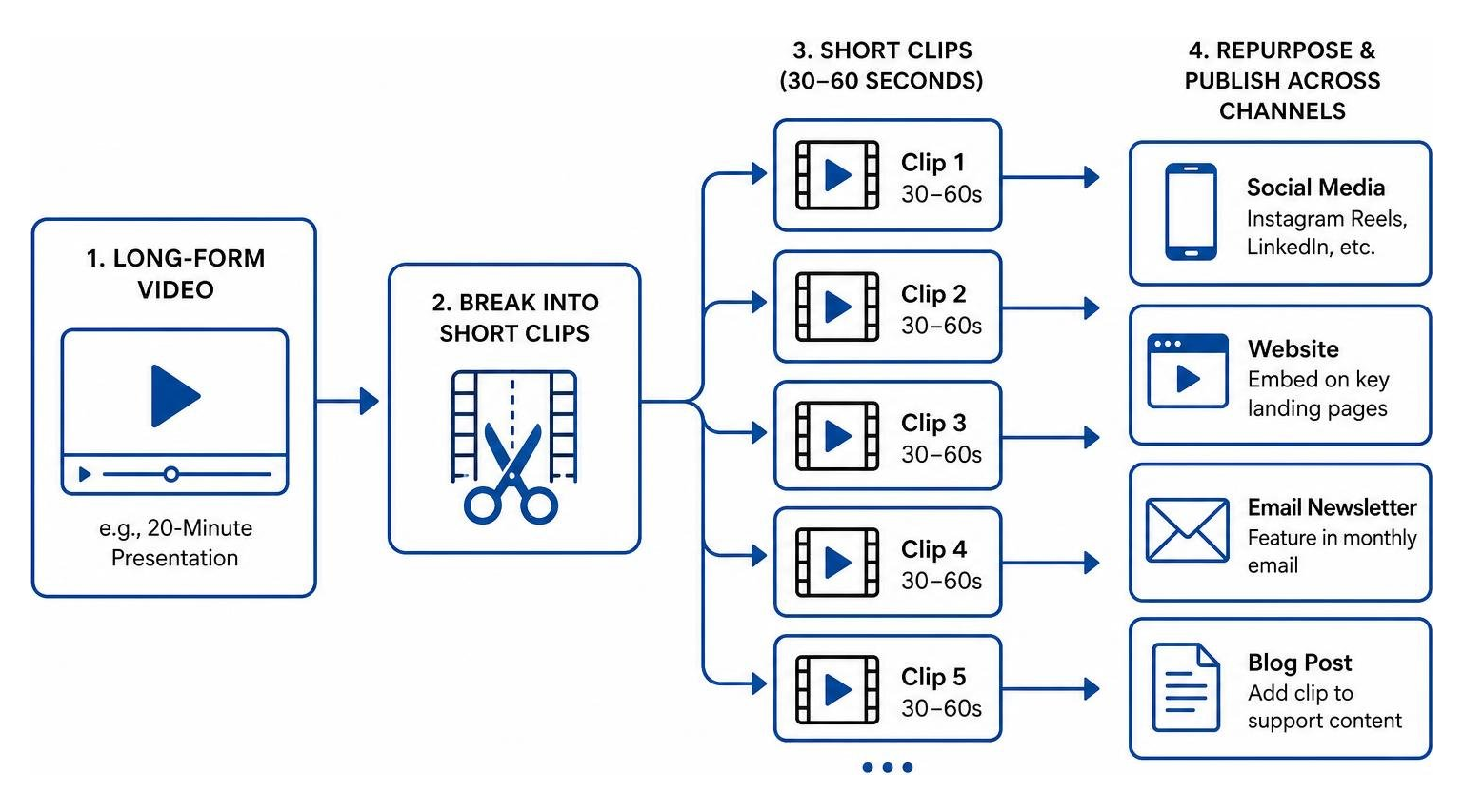
Almost 90 percent of teams reuse their long video content and webinars. A single long recording can become:
- Short 30-second clips for Instagram Reels and LinkedIn
- An embedded video on a key website landing page
- A featured clip inside your monthly email newsletter
- A video snippet attached to a blog post
This approach gives you a continuous stream of fresh content without requiring you to stand in front of a camera every single day. For step-by-step shortcuts on turning existing footage into engaging posts, take a look at The Lazy Creator’s Guide to Making Reels Using Existing Video Clips.
Simple Ways to Measure Video Results and Use AI
When you start sharing videos, it is easy to get caught up in tracking vanity metrics like views and likes. While seeing a high view count can feel exciting, views alone do not pay the bills or bring new clients through your door. A video with 200 views from local homeowners in Fort Worth who actually hire you is infinitely more valuable than a video with 10,000 views from people across the world who will never buy from you.
To accurately gauge whether your video content is succeeding, you must look at actionable metrics that tie directly to customer intent and business growth.
Key Metrics That Actually Matter
Here is a simple comparison between surface-level metrics and the real business metrics that matter for your bottom line:
| Metric Type | What It Tracks | Why It Can Be Misleading | What to Measure Instead | Real Business Impact |
|---|---|---|---|---|
| Vanity Metrics | Raw Views, Likes, Shares | High view counts do not guarantee local interest or buying intent. | Watch Duration & Play Rate | Shows if people actually found the topic interesting enough to stay. |
| Engagement Metrics | Comments, Claps, Emoji Reactions | Anyone can drop a quick reaction without watching the full video. | Completion Rate & Drop-off | Pinpoints exact moments where viewers lose interest or tune out. |
| Sales & Growth Metrics | Profile Visits | Visiting a profile does not automatically translate to sales. | Website Clicks, Leads & Inquiries | Measures how many viewers took real action to contact your business. |
Tracking these key metrics keeps your strategy anchored in real growth:
- Play Rate: The percentage of website visitors who click play on your video. Placing videos on homepages, product pages, and contact pages usually yields the highest play rates.
- Completion Rate: How much of the video people watch before clicking away. If viewers drop off after five seconds, your hook needs work. If they stay through 80 percent, your message is landing well.
- Website Traffic and Conversions: Tracking how many people click the link under your video to visit your site, fill out a contact form, or book an appointment.
How AI Is Changing Video Creation
Artificial intelligence has completely transformed how small businesses approach video production. More than a third of video teams actively use AI in their workflows, and daily video producers are 58 percent more likely to adopt AI tools.
AI is not here to replace your authentic voice or put robot avatars on screen; it is here to handle tedious tasks so you can save time.
Here are the top practical use cases for AI in small business video creation:
- Script Drafting and Brainstorming: Inputting customer questions into AI assistants to generate clean video outlines and talking points in seconds.
- Automated Subtitles and Captions: Generating precise, multi-language captions instantly so sound-off viewers can follow along. AI users are 82 percent more likely to offer multi-language subtitles.
- Audio Enhancement and Editing: Automatically removing background noise, long pauses, and filler words like “um” or “ah” from your raw recording, making you sound clear and polished.
By using AI for early pre-production planning and post-production cleanup, small teams can produce professional-looking videos in a fraction of the time.
Frequently Asked Questions about Video Marketing
Do I need expensive camera gear to start video marketing?
No, you absolutely do not need expensive camera equipment. Modern smartphones record in crisp High Definition (1080p) and even 4K resolution, which is more than sufficient for high-quality marketing videos.
Instead of buying expensive cameras, focus on two simple elements: light and sound. Position yourself facing a bright natural window or use an affordable ring light. For clear audio, purchase a simple clip-on lavalier microphone that plugs directly into your smartphone. Clear audio and good natural lighting matter far more to viewers than high-end camera lenses.
How often should a small business publish videos?
Consistency is far more important than daily volume. Around 76 percent of active business video teams create at least one video per month, while many active local brands post one to two short clips per week on social media.
Establish a manageable schedule that you can comfortably maintain. Publishing one thoughtful, well-planned video every single week will build far better momentum and audience trust than posting ten videos in three days and then going completely silent for two months.
What is the ideal video length for beginners?
For social media platforms like Instagram Reels, TikTok, and LinkedIn, short clips between 30 and 60 seconds perform best because online attention spans are quick. Make sure to deliver your main hook and introduce your core point within the first five seconds.
If you are creating an explainer video, a product demo, or an educational tutorial for your website, a length of 90 seconds to two minutes is ideal. For deeper topics, long-form videos can still perform remarkably well, but starting short keeps production simple and keeps viewer drop-off low.
Conclusion
Video marketing is no longer an optional tactic reserved for large corporations with massive advertising budgets. It has become an essential tool for local business owners in Keller, Southlake, Trophy Club, Roanoke, North Richland Hills, and Fort Worth who want to stand out, earn community trust, and grow their customer base.
By focusing on authentic storytelling, answering real customer questions, leveraging short-form social formats, and utilizing modern tools to keep production simple, you can build a high-impact video strategy without overwhelming your schedule or budget.
At Kickin’ It Media Group, we specialize in helping local businesses across the DFW area tell their stories effectively. Whether you need hands-on assistance with professional media production, localized SEO, web strategy, or social media management, our team is here to guide you every step of the way. Explore our full range of custom Services – Video Photography Services today, and let us help you turn simple video content into lasting business growth.