What Brand Leadership Positioning Really Means (And Why It Matters)
Brand leadership positioning is the strategic process of deliberately defining how your brand occupies a distinct, valuable place in your customer’s mind — and it starts at the top of your organization, not inside a marketing plan.
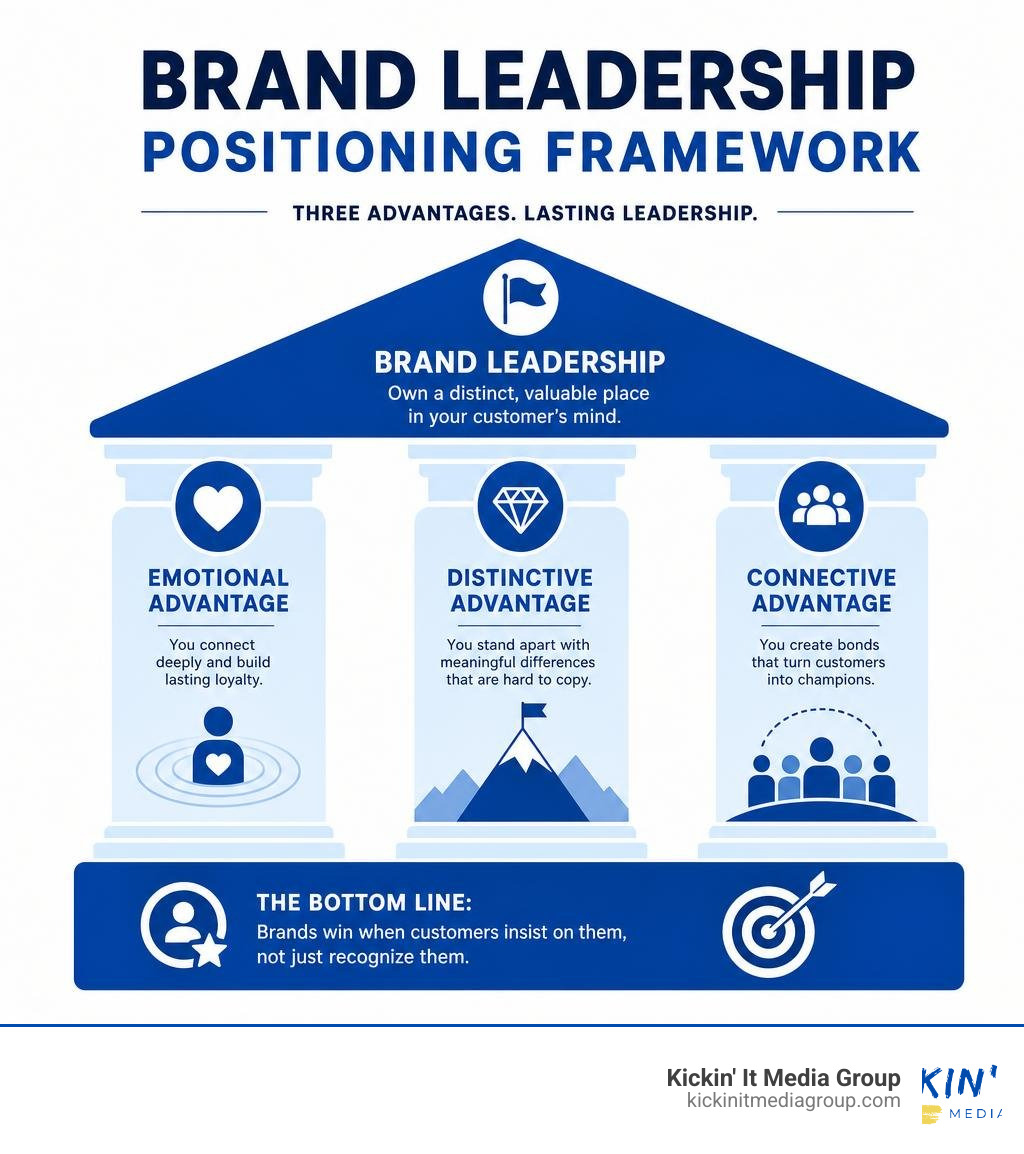
Here’s a quick breakdown of what it means and why it matters:
- What it is: A set of strategic choices about who your brand is for, what it competes on, and what it will not pursue
- Who owns it: Leadership — not the marketing team, not a designer, not an agency
- Why it matters: When positioning is clear, culture aligns, strategy focuses, and customers choose you over competitors — repeatedly
- What it drives: Emotional advantage, distinctive advantage, and connective advantage that competitors cannot easily copy
- The bottom line: Brands win when customers insist on them, not just recognize them
Most small business owners think of brand positioning as a tagline, a logo, or a color palette. It’s none of those things.
Positioning is the answer to a harder question: Why should someone choose you over every other option available to them?
When that answer is vague — or left up to whoever handles your social media that week — your brand becomes easy to overlook and easy to replace. Customers can’t connect with something they can’t clearly understand.
The good news? You don’t need a Fortune 500 budget to get this right. You just need clarity, intention, and a willingness to make some real strategic choices about who you are and who you serve.
I’m Ashley Stone, founder of Kickin’ It Media Group, and I’ve spent my career helping small businesses in the Keller/Fort Worth area build brands that are clear, consistent, and compelling — which is exactly what brand leadership positioning is all about. If you’ve ever felt like your business isn’t being taken seriously online or struggled to explain what makes you different, this guide was written for you.
Why Brand Positioning is a Strategic Leadership Decision
Many business owners treat brand positioning as a creative exercise. They delegate it to a marketing manager, hire an agency to write a catchy slogan, or assume that a shiny new logo will solve their sales problems.
This is a fundamental misunderstanding of how brands actually work.
True brand positioning is a leadership responsibility. It requires active executive alignment because it is built on strategic trade-offs. You cannot position your brand to be everything to everyone. To stand for something specific in the minds of your customers, you must deliberately decide what your business will not pursue.
When leadership fails to own this decision, the business suffers. Without a clear, single strategic filter from the top, your sales team will pitch one message, your product developers will build features for a different audience, and your marketing team will run campaigns that try to please everyone. This internal fragmentation quickly turns into external inconsistency, making your brand harder for customers to understand and easier for competitors to replace.
If you want to build a brand that resonates deeply while remaining incredibly true to your core mission, you have to start with leadership clarity. We dive deep into how to balance authenticity with commercial appeal in our guide on How to Build a Brand That Feels Like You and Still Sells.
The Three Pillars of Brand Advantage
Brands that successfully establish leadership in their markets do so by securing three distinct advantages in the minds of their customers:
- Emotional Advantage: This is the gut-level feeling a customer has when they think of your brand. It moves your relationship past transactions and into the realm of shared values. Customers don’t just buy what you make; they buy why you make it.
- Distinctive Advantage: This is the unmistakable space you occupy that separates you from the crowd. It is the specific benefit or attribute that your brand owns so completely that competitors cannot claim it without looking like copycats.
- Connective Advantage: This is the bridge built between your brand’s daily operational actions and your customer’s daily life. It represents deep customer trust, earned over time through consistent, predictable experiences.
Aligning Culture and Execution with Brand Essence
To sustain these advantages, your brand positioning must be anchored in something real: your brand essence, your brand personality, and your brand archetype. These elements act as the internal blueprint for your corporate culture.
Your brand essence is the core soul of your business. It is the single, unchanging idea that drives everything you do. When your team understands this essence, they don’t need a massive rulebook to make decisions; they simply ask themselves if a decision aligns with who the brand is.
This alignment between internal culture and external execution is what separates iconic brands from flash-in-the-pan marketing campaigns. For a deeper academic and strategic look at how these elements form the foundation of sustainable business models, you can read more about [PDF] BRAND POSITIONING: STRATEGIC APPROACHES for … – IARJSET .
Common Pitfalls in Brand Leadership Positioning
Even the most well-meaning leadership teams fall into predictable traps when trying to position their brands.

The most damaging mistake is the “split-discipline” model. This happens when an organization treats brand positioning (how the company is perceived as a whole) and product positioning (how individual products are sold) as two entirely separate initiatives managed by different departments.
A customer’s mind does not have separate compartments for your corporate brand and your product features. A mind holds exactly one position per brand. When you try to feed customers two different stories, they simply tune out.
This misalignment has led to catastrophic, multi-billion-dollar brand equity losses for some of the world’s most famous companies. Think of historical pricing missteps, confusing logo redesigns, or legacy brands trying to target a completely different demographic overnight without respecting their accumulated position. When leadership treats positioning as a flexible, temporary marketing campaign rather than a protected asset, they violate the single filter their customers use to evaluate them.
To understand how high-stakes these positioning violations can be, read the brilliant analysis of brand refusals and market reactions in The Prancing Horse | Platonic — Blog of Paul Syng .
The Danger of Treating Positioning as a Marketing Deliverable
When positioning is treated as a scheduled marketing deliverable — a document to be checked off, filed away, and refreshed every year — it loses all its power.
True positioning is defined by operational refusals. It is proven by what your company refuses to do.
- It is a luxury brand refusing to increase production to meet high demand because doing so would destroy its exclusivity.
- It is a value-focused retail giant refusing to raise the price of its signature hot dog for forty years, even building its own manufacturing plants to protect that single price point.
These are not marketing decisions; they are operational sacrifices made at the executive level. If your positioning statement says you stand for one thing, but your operations division makes decisions that contradict it, your marketing copy is nothing more than expensive noise.
Using Perceptual Maps and Research for Differentiation
To find an authentic, defensible position, you cannot rely on gut feeling alone. You must ground your decisions in objective customer research, identifying the actual choice drivers in your market and mapping them against the competitive frame.
A common debate among business owners is whether to build their brand positioning around their unique differentiators or simply double down on what they are already good at. The truth is, you must do both, but they serve different purposes.
| Strategy Type | Focus | Primary Goal | Customer Perception |
|---|---|---|---|
| Differentiation Strategy | Owning an uncontested, unique benefit | Creating a psychological monopoly | “They are the only ones who do this.” |
| Capability-Based Strategy | Executing standard industry services exceptionally well | Outperforming direct competitors on quality/speed | “They are the best at doing this.” |
Mapping the Competitive Landscape
One of the most practical tools for visualizing your market space is perceptual mapping. This involves plotting your brand and your competitors on a simple two-axis grid based on the key attributes that matter most to your target customers (for example, price vs. quality, or convenience vs. customization).
By visualizing the market this way, you can easily spot “white space” — uncontested areas where customer needs are currently unmet by market alternatives. This research-backed approach ensures your brand doesn’t end up looking like everyone else in the DFW metroplex. If you’re building your brand assets yourself and want to make sure your visuals match this professional, differentiated strategy, check out our guide on DIY Brand Tips That Don’t Look DIY.
The Four Requirements of a True Brand Leadership Positioning Advantage
Before you commit to a specific positioning benefit, it must pass a rigorous four-part pressure test. A true brand leadership benefit must meet these exact criteria:
- It matters deeply to the target customer: If your audience doesn’t care about the benefit, it doesn’t matter how unique it is.
- The organization can actually deliver it: You must have the operational capability, culture, and intent to back up the claim every single day.
- Competitors are not delivering it: It must represent a clear gap in the market that competitors would struggle to replicate.
- It is clear, compelling, and believable: The market must easily understand the claim and believe your reasons to believe (RTBs).
Crafting the Perfect Brand Positioning Statement
Once you have done the research and selected your defensible market space, you need to document it. This is done through a brand positioning statement.

Remember: this is an internal strategic compass, not a public-facing tagline. Its job is to align your leadership team, guide your content creation, and keep your business focused.
The Five-Step Positioning Framework
To write a positioning statement that actually drives business growth, follow this systematic five-step framework:
- Define Your Target Audience: Go beyond basic demographics. Identify their specific pain points, behaviors, and what they stand to lose if they choose the wrong option.
- Understand Your Competition: Clearly define your competitive frame of reference. Who or what are your customers comparing you to?
- Articulate Your Unique Differentiators: State the single, most impactful capability or benefit that sets you apart.
- Provide a Reason to Believe (RTB): Back up your claim with undeniable proof, whether that is proprietary technology, a unique business model, or a historical track record.
- Craft the Final Statement: Combine these elements into a single, cohesive formula.
Use this classic, battle-tested formula to write yours:
For [Target Market] , our brand is the only one among all [Competitive Set] that [Unique Value Claim] because [Reasons to Believe] .
Measuring the Success of Your Positioning Strategy
How do you know if your brand positioning is actually working? While creative elements are subjective, the success of your positioning strategy is highly measurable.
Look for these key indicators:
- Brand Awareness: Are more people in your target demographic recognizing your brand name and immediately associating it with your core attribute?
- Market Share: Are you winning a larger slice of the regional market pie?
- Customer Feedback: When customers review your business or talk to your team, do they use the exact words from your positioning statement to describe why they love you?
- Brand Insistence: This is the ultimate goal. It occurs when a customer refuses to accept any substitute. They will drive past three competitors or wait weeks on a waitlist just to buy from you because they insist on your brand.
To turn this high-level positioning strategy into local, high-converting digital campaigns across Keller, Southlake, and the wider Fort Worth area, you need a cohesive online approach. Explore our full suite of Digital Marketing services to see how we bring brand positioning to life online.
Real-World Case Studies of Brand Leadership Positioning
Let’s look at how world-class brands use distinct positioning strategies to build what we call a “psychological monopoly” — a space where they have no real alternative in the customer’s mind.
Bobbie: The Activist Brand
The organic baby formula brand Bobbie completely disrupted a massive, slow-moving industry. Instead of competing solely on product ingredients, they positioned themselves around parental advocacy and systemic policy change. Led by Chief Brand Officer Kim Chappell, they championed parental leave and modern family support, turning their customers into passionate advocates. This values-driven approach propelled them to over $150 million in revenue, making them the third-biggest formula brand in the US and earning them a spot on the Times100 Most Influential Companies list. Read the full, inspiring interview on Bobbie baby formula brand chief Kim Chappell: ‘Our goal is policy change’ | The Drum .
Volvo: The Safety Standard
In 1959, Volvo invented the three-point seatbelt. Instead of keeping the patent to make billions in licensing fees, they gave it away to competitors for free to save lives. This single, massive operational refusal to put profit over safety cemented their position as the safest car brand on earth for decades. The product was technically identical to what others could build, but the positioning created an untouchable brand association.
HubSpot: Creating the Category
Instead of trying to position themselves as a slightly better CRM in a crowded software market, HubSpot did something brilliant: they gave a name to a methodology that already existed. By coining the term “Inbound Marketing” in 2005, they built an entire educational ecosystem around it. They became the default authority for the very category they created, growing into a multi-billion-dollar powerhouse.
To learn more about how category creation and psychological monopolies can transform a business’s bottom line, read the guide on Brand Positioning: How to Become the Only Choice in Your Customer’s Mind | The Launch Pad .
Furthermore, as a business leader, defining this organizational difference is your absolute highest priority. For a deep dive into why this responsibility belongs on the CEO’s desk, check out the executive insights in Your Brand’s Position .
Frequently Asked Questions about Brand Positioning
What is the difference between brand positioning and product positioning?
Brand positioning defines the overall identity, core values, and competitive frame for your entire company. Product positioning defines how a specific product or service is perceived within its individual market category. For small businesses and local service providers, these two should align almost completely to avoid confusing your audience.
How often should a company revisit its brand positioning?
While you should monitor competitive threats and major market shifts continuously, your core brand positioning should remain stable for years. True positioning relies on consistency to build memory structures in the customer’s mind. You should only undergo a major repositioning exercise if your business model fundamentally changes, your target market disappears, or your current position has become entirely commoditized.
Can positioning change a product’s perceived value without changing the product itself?
Absolutely. This is the magic of strategic positioning. By changing the competitive frame of reference — the category you compare yourself to — you change the criteria customers use to evaluate your price. For example, a bottle of water positioned as “basic hydration” is compared to tap water and priced at a dollar. That exact same water, positioned as “pure artesian luxury from a Norwegian spring,” can easily command ten times the price because it is compared to fine wines and premium lifestyle experiences.
Conclusion
At the end of the day, brand leadership positioning isn’t about finding clever tricks to sell products. It is about having the courage as a leader to decide who you are, who you serve, and what you stand for — and then having the operational discipline to live those choices every single day.
When you get this right, you stop chasing leads and start building a community of loyal advocates who wouldn’t dream of going anywhere else.
At Kickin’ It Media Group, we specialize in helping businesses across Keller, Southlake, Trophy Club, Roanoke, North Richland Hills, Fort Worth, and the entire DFW metroplex find their unique voice and claim their rightful place in the market. We combine agency-level strategic depth with local, hands-on creative execution to turn your business’s core strengths into an unfair competitive advantage.
Ready to stop blending in and start leading your market? Explore our professional Brand Development services, and let’s build a brand that feels like you, sells like crazy, and stands the test of time.
Related Posts








Recent Comments